Description
Buy Facebook Group Members
Scale your community authority and audience engagement with authentic social proof! When you choose to Buy Facebook Group Members from trusted service platforms, your group receives active member additions that boost overall brand trustworthiness. A higher member count makes new visitors more likely to join, engage with your pinned posts, and convert into long-term clients. Learn how to Buy Facebook Group Members using safe, non-drop, and high-retention packages designed for public and private groups alike.
If you want faster traction on social media, buying Facebook group members may sound like a great way to build momentum. In practice, this can mean paying for added members or acquiring a group that already has an audience. Many group owners like the idea because a larger group stands out in the Facebook groups section and may look more established. Still, numbers alone do not guarantee value. What matters most is whether those members are real, active, and useful to your long-term goals.
Top Ways to Buy Facebook Group Members for Your Group
There are several ways people try to buy Facebook group members, and each one works differently. Some methods focus on adding new members through outside providers. Others involve full group ownership transfers, where you buy an existing group with an established audience.
If you are considering the second option, the process usually starts in the Facebook groups section with research, outreach, and due diligence. A group admin may agree to sell, add you as an admin, and then remove themselves after payment is secured. The method you choose should match your goals, budget, and how Facebook’s algorithm responds to your group activity.

1. Purchasing Members from Social Media Growth Services
One common starting point is using social media growth services that promise new members for your group. For a busy group admin, this may feel easier than building from zero. The appeal is simple: you pay, the service adds numbers, and your group looks larger to Facebook users who discover it.
Before choosing a provider, you should stay focused on quality. The compiled information makes one point clear: an engaged group matters more than a large group with weak activity. Ask whether the new members are active and whether the service can show growth metrics that match real interaction.
- Check if the provider can explain how members are added.
- Ask for proof of active participation, not only the number of members.
- Review whether customer support can answer due diligence questions.
At the same time, remember that visible growth without real engagement can become a bad thing for your community over time.
2. Buying Facebook Group Members via Online Marketplaces
Another route people consider is using online marketplaces tied to social media platforms. In many cases, what is really being sold is not random members but access to an existing Facebook asset. That might include a group, a Facebook page, or other audience-based property.
Pricing is not fixed. Based on limited data from actual group acquisitions, purchases ranged from about $0.046 to $0.533 per member. That gives you a starting point, not a guaranteed rate. A 54,000-member group was acquired for $2,500, while smaller groups had higher per-member costs.
- A 54,000-member group cost $2,500.
- A 2,900-member group cost $300.
- A 1,500-member group cost $800.
So how much does it typically cost? It depends on engagement, niche relevance, and whether the group admin is selling a healthy audience or just a big headcount.
3. Partnering with Niche Facebook Group Vendors
Working with niche Facebook group vendors usually means targeting communities that already speak to the exact audience you want. This is closer to strategic group ownership than broad member buying. Instead of chasing any traffic, you look for Facebook groups where Facebook users already care about your topic.
There is at least one strong case study in the compiled information. A 54,000-member group was purchased for $2,500, then used to drive traffic, sell brand shoutouts, and support a broader asset portfolio. Over about 10 months, the group grew to around 63,000 members, showing a 17% growth trend.
- The buyer recouped costs through $500 shoutouts.
- The group helped support traffic back to a niche site.
- The asset could improve future sale value.
That does not mean every purchase wins, but it shows that relevant groups can create value when the audience is genuine and aligned.
4. Leveraging Digital Marketing Agencies for Group Growth
Digital marketing agencies are often brought in when someone wants managed group growth without handling every step alone. In social media terms, this can include outreach, scheduled posting, or broader promotion aimed at attracting new members more quickly.
Still, there is a clear difference between paid growth and organic growth. Buying or acquiring members may speed up visibility, but it can also create risk if the audience is inactive, poorly matched, or dependent on artificial methods. Organic growth tends to build stronger conversation habits because people join by choice and take part naturally.
- Paid growth may raise numbers faster than trust.
- Organic growth usually gives healthier engagement metrics.
- Weak member quality can reduce long-term value.
If you compare the two, the biggest risk of buying is ending up with a group that looks good from the outside but lacks real discussion inside.
5. Joining Facebook Group Exchange Communities
A Facebook group exchange can sound like a low-cost shortcut. In these spaces, admins help each other swap exposure, referrals, or access to new members. It may seem safer because the process looks more community based and less transactional.
Even so, safety and effectiveness depend on member quality. The compiled information stresses that community building works best when a healthy group has active discussion, steady posting, and useful comments. If an exchange sends people who do not care about your topic, your count may rise while your engagement stays flat.
- Review the Facebook groups section to see if exchange groups match your niche.
- Measure whether new members comment, react, or post.
- Avoid assuming fast growth means durable growth.
So, is it safe and effective? It can be less risky than blind buying, but only when the exchange brings relevant people who actually want to stay involved.
6. Opting for Automated Tools to Increase Group Members
Some people use automated tools to increase group members or manage posting after acquisition. The compiled information mentions scheduling tools used to post regularly, which helped drive traffic. That said, tools are only helpful when they support real activity rather than replace it.
To tell whether bought group members are real and active users, look beyond the join number. A group admin should review growth insights, engagement insights, and the Facebook backend when possible. Compare active members with total group members, then manually inspect the feed.
- Check whether posts receive comments from different Facebook users.
- Review if the same small group is doing all the talking.
- Ask for screenshots from the Facebook backend showing trends.
This is the best way to separate genuine participation from inflated numbers that do little for your group’s long-term health.
7. Utilizing Referral-Based Member Buying Programs
Referral-based programs try to make growth look more natural by sending new members through recommendations, partner communities, or direct outreach. In theory, this sounds better than buying random accounts because referred people may have some interest in your topic.
Even with that advantage, you still need to think about platform rules. The compiled information does not list formal Facebook policy language, but it does show that Facebook’s algorithm and platform structure reward real engagement. That means any method that creates low-quality joins or forced participation can work against you.
- Ask providers to explain exactly how referrals are sourced.
- Review the Facebook group feed after new members arrive.
- Use Facebook message outreach carefully and transparently.
So yes, rule concerns do exist in a practical sense. If a method looks manipulative or creates weak activity, it may put your group quality at risk.
8. Joining Paid Facebook Group Growth Platforms
Paid Facebook group platforms often package group growth as a service. Some offer member delivery. Others connect buyers with existing groups for sale. If you want a mature audience instead of just raw new members, buying an existing group may be the more direct option.
The process for buying a group with existing members is fairly simple. First, identify targets through search or cold outreach on social media platforms. Then review growth metrics, engagement metrics, post quality, and moderator dynamics. Once terms are agreed, payment can be secured through escrow, the seller adds you as admin, and then steps down so full control transfers.
- Find relevant groups and contact the current admin.
- Complete due diligence before payment.
- Confirm group ownership transfer before releasing funds.
This route is often more structured than buying member packages, though it still requires careful review.
Key Benefits of Buying Facebook Group Members
Buying Facebook group members can create momentum, especially when you are trying to build early visibility. For a group admin, a larger audience may support brand authority, improve first impressions, and make the group look active enough for others to join.
That said, the compiled information suggests the main benefit is often increased numbers first, not guaranteed engagement metrics. Facebook’s algorithm still favors content and interaction quality. So yes, buying can help the appearance of growth, but real value comes when those new members also support traffic, conversation, or monetization opportunities.
Boosting Your Group’s Visible Member Count
The most obvious benefit is a higher number of members. When people browse the Facebook groups section, size influences perception. A group admin with a larger audience may attract more clicks simply because the group appears busier and more established.
This matters because Facebook users often judge a community before they join it. If the group looks empty, they may skip it. If it has a stronger visible member base, they may assume it offers more answers, more activity, and a better chance to connect with others in the same niche.
Still, the number of members should never be your only goal. The compiled information repeatedly shows that engagement metrics, active posting, and useful comments are what separate a healthy group from a weak one. Visible size can open the door, but member behavior is what keeps the group valuable after people enter.
Gaining Quick Social Proof and Credibility
A higher member count can create quick social proof. When people see a group with established activity, they often assume it has value. For a group admin, that can improve credibility during the early stage when the group still needs trust.
This can also support business goals tied to group ownership. In the compiled case study, a large group made the owner’s wider social portfolio more attractive to brands. That led to paid shoutouts and a stronger position when offering promotional deals tied to Facebook posts.
- A larger group can look more trustworthy at first glance.
- Brands may be more open to partnerships when credibility is visible.
- Group ownership can feel more valuable when the audience looks established.
Social proof helps people pay attention, but it works best when your group also shows real discussion and relevant content once they join.
Making New Groups Appear More Established
In the initial stages of a group, appearance matters. A new community with only a handful of members can struggle to build momentum, even if the topic is strong. Adding new members can be a great way to reduce that empty-room feeling.
For a group admin, this can make the Facebook group feed look more promising to first-time visitors. More members can encourage others to post questions, react to content, and treat the space as active rather than ignored. That early perception may help a group get past its slowest phase.
- It can make a brand-new group feel less risky to join.
- It may encourage first posts and early replies.
- It helps avoid the look of a stalled launch.
Still, the compiled information shows that the group must grow into a healthy group. Appearance alone does not build lasting value if members never participate.
Main Risks to Consider Before You Buy Facebook Group Members
Buying members can save time, but it also brings real risk. The biggest issue is quality. On social media platforms, a large audience means little if Facebook users do not post, comment, or stay active after joining.
This is where buying differs from organic growth. Group ownership and group acquisitions can create value when the audience is real and engaged. But if you buy weak members, you may face poor discussion, trust problems, and a group that looks better on paper than it performs in practice.
Potential for Inactive or Fake Accounts
One of the clearest risks is ending up with inactive accounts or fake accounts. A group admin may pay for growth, see a jump in numbers, and later realize those members never take part in the community. That creates major quality issues.
The compiled information puts heavy weight on active members, daily additions, and healthy engagement. It also warns against groups where only a few people participate. If most of the audience is inactive, your group may seem large but still feel empty when real Facebook users visit it.
This is why manual review matters. Check the feed. Look at comments. See whether questions receive useful replies from a broad mix of people. A strong group does not depend on a few visible names or inflated numbers. If the activity is shallow, the member increase may have little real value for traffic, trust, or future monetization.
Low Engagement and Minimal Comments
A high member count can hide a low engagement problem. This happens when people join but do not comment, react, or start discussions. For group owners, that gap becomes obvious once Facebook posts receive little response despite a large audience.
The compiled case study offers a useful lesson here. Traffic could be driven from a group to a site, but posts that pushed people off Facebook often got weaker response because the platform prefers users to stay inside it. That means engagement metrics may stay modest even in a large community.
- Watch for posts with few comments despite many members.
- Compare reactions, comments, and daily posting activity.
- Do not judge success only by growth screenshots.
Across social media platforms, an audience without interaction is hard to monetize and even harder to turn into a lasting community. Low engagement is often the warning sign that the member base is not as valuable as it looks.
Risk of Member Removal by Facebook
Another concern is member removal. The compiled information does not provide a formal Facebook platform policy statement about buying and selling group members, but it does show that Facebook’s algorithm and internal systems reward authentic use. If joined accounts are low quality, they may not stay.
A practical group admin should assume that suspicious growth can lead to instability. If members disappear, your number drops, your engagement mix shifts, and your group may look less reliable to real Facebook users. That is why screenshots from the Facebook backend and manual review are so important before any purchase.
| Risk area | What it may mean for your group |
|---|---|
| Member removal | Added members may not remain, reducing your visible size over time |
| Weak account quality | Low-value accounts may never engage in useful ways |
| Algorithm mismatch | Facebook’s algorithm may not reward shallow activity |
| Policy concern | Any method that appears manipulative may create uncertainty |
So, while the exact policy language is not covered here, the operational risk is clear: unstable member quality can hurt your results.
Possible Trust and Quality Issues in Your Community
Trust is easy to lose and hard to rebuild. If your audience notices low-value discussions, spammy posts, or weak participation, trust issues can spread quickly. That affects quality issues inside the group and also shapes how outsiders view your brand authority.
This matters because group ownership is not only about access to people. It is also about community building. The compiled information highlights the value of useful comments, real questions, and members who help each other. When those elements drop, the group becomes less attractive as a business asset.
- Members may stop posting if the space feels low quality.
- Brands may see less value in shoutouts or partnerships.
- New visitors may question the credibility of the community.
A group can look impressive from the outside, but if the inside experience feels thin, your long-term value may shrink instead of grow.
Concerns About Facebook Platform Policy Violations
Every group admin should think about compliance, even when the rules are not spelled out in detail. The compiled information focuses more on due diligence and group quality than on legal wording, yet the warning is still relevant: methods that create poor-quality participation can work against your goals in Facebook groups.
That matters if you rely on related tools or promotions such as Facebook ads, brand deals, or outside traffic campaigns. A group that grows in a questionable way may still gain members, but it may not support stable business use if the audience is not authentic.
- Treat unclear sourcing methods as a warning sign.
- Avoid buying that depends on fake or forced activity.
- Prioritize healthy group behavior over quick wins.
In simple terms, potential violations are less about one shortcut and more about whether your growth method creates a real, useful community or an artificial one.
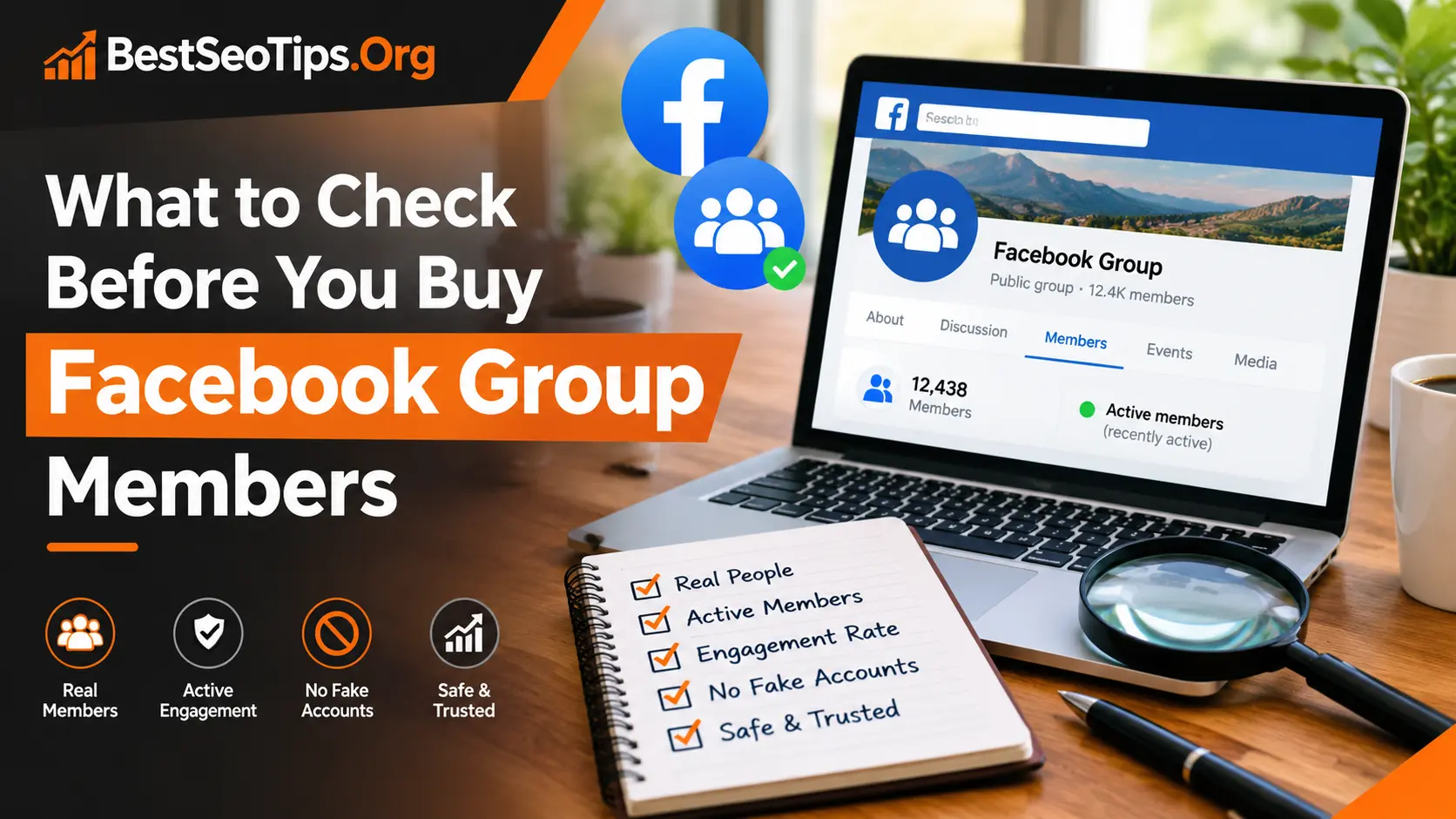
What to Check Before You Buy Facebook Group Members
Before you spend money, do your due diligence. A careful group admin should review growth patterns, feed activity, and seller claims before buying members or considering group acquisitions. The goal is not just to buy size. It is to buy value.
Across Facebook groups, the best sign of quality is consistent participation from many people, not a few repeated names. You should also ask direct questions, check screenshots, and test customer support responses. Those simple checks can help you spot whether the audience is real, active, and worth the investment.
Assessing the Quality and Authenticity of Members
Start with quality and authenticity. If you are comparing sellers, these two factors matter more than any promise about speed. A group admin should ask whether the audience is active, niche-relevant, and broad enough to support normal discussion.
The compiled information gives a practical framework for this. Review growth insights and engagement insights together. A group may have large numbers, but if active members are low or comments are weak, the value drops. This matters for both member buying and full group acquisitions.
Then go one step further. Manually review the feed and look at what Facebook users are actually saying. Are they asking questions, sharing insights, and helping each other? Or are the same people carrying every thread? Authenticity shows up in behavior. If the conversation feels natural across many members, that is a stronger sign that the audience is real and worth considering.
Understanding Delivery Methods and Speed
Delivery methods and speed also matter. Fast growth can look exciting, but you should ask how the new members arrive and whether that pace makes sense. A sudden spike without matching interaction can be a warning sign.
The compiled information favors steady, healthy activity over artificial jumps. When a group is healthy, new members are added daily, posts keep coming, and engagement stays visible in the Facebook group feed. If a seller cannot explain the source or timing, that weakens trust from the start.
- Ask whether growth is delivered gradually or all at once.
- Compare delivery claims with screenshots from the Facebook backend.
- Review the Facebook group feed after delivery begins.
Speed should never be your only filter. A slower method tied to real interest is often more useful than a fast one that creates empty numbers and little ongoing discussion.
Reviewing Retention and Refill Guarantees
Retention tells you whether the growth lasts. Refill guarantees sound helpful, but they only matter if the original members were worth having in the first place. A group admin should ask not just whether dropped members will be replaced, but why they might leave so quickly.
This is important because long-term value comes from a stable audience. The compiled information points to daily activity, steady discussion, and broad participation as the signs of a healthy group. If members vanish and need constant replacement, your Facebook group feed may never develop real momentum.
- Ask how long members usually stay after joining.
- Clarify what triggers refill guarantees and how quickly they are handled.
- Test customer support before buying anything substantial.
A refill promise can reduce short-term risk, but it does not solve deeper quality problems. Retention matters because it shows whether your growth is durable or only temporary.
Evaluating Customer Support and Security Practices
Good customer support is a basic trust signal. If a provider avoids clear answers, that alone should make you pause. A serious group admin needs direct responses about sourcing, delivery, quality, and what happens if something goes wrong.
Security matters too, especially in transactions involving existing Facebook groups. The compiled information describes a safe transfer process: secure payment first, admin access second, and final release only after full control is confirmed. That reduces risk during ownership transfer.
- Use clear written communication, including Facebook message records when relevant.
- Ask how the provider protects access during group handover.
- Confirm they do not require unsafe account-sharing steps.
In short, support and security are not side issues. They are part of due diligence. If the seller cannot manage basic communication or safe transfer steps, the deal may not be worth pursuing.
Frequently Asked Questions
Can You Buy Facebook Group Members?
Yes, you can buy Facebook group members through various methods like social media growth services, online marketplaces, and influencer networks. However, consider the potential risks such as fake accounts and policy violations, ensuring you choose reliable sources for authentic engagement.
Is It Safe to Buy Facebook Group Members?
Buying Facebook group members can be risky. You may encounter fake or inactive accounts, leading to low engagement and possible removal by Facebook. It’s crucial to assess the legitimacy of services carefully to avoid violating platform policies and jeopardizing your group’s credibility.
Does Buying Facebook Group Members Increase Engagement?
Buying Facebook group members can lead to a perception of increased engagement, but it doesn’t guarantee genuine interaction. Often, purchased members may not actively participate, resulting in low-quality engagement, which can hinder the authenticity and growth of your community over time.
Will Bought Facebook Group Members Stay Permanently?
Bought Facebook group members may not stay permanently. Many purchased accounts can be inactive or removed by Facebook, leading to a decline in numbers. It’s essential to prioritize quality and authenticity when acquiring members to foster a more engaged community.
How Much Does It Cost to Buy Facebook Group Members?
The cost of buying Facebook group members varies significantly based on the service provider, quality of members, and quantity purchased. Prices can range from a few dollars for low-quality members to hundreds for targeted, high-engagement accounts. Always evaluate the ROI before committing.
Will Bought Facebook Group Members Like or Comment on My Posts?
Bought Facebook group members may not actively engage with your content through likes or comments. Many purchased members are inactive or fake accounts, which can lead to low engagement levels and minimal interaction on your posts, affecting overall group dynamics.
Can Facebook Remove Bought Group Members?
Yes, Facebook can remove bought group members if they identify them as fake or inactive accounts. This action can affect your group’s credibility and member count, potentially leading to decreased engagement and trust within your community. Always prioritize authentic growth strategies.
Do I Need to Give My Facebook Password to Buy Group Members?
No, reputable services do not require your Facebook password to buy group members. Sharing your password can compromise your account’s security. Always choose trustworthy providers that utilize safe methods for enhancing your group’s membership without compromising your privacy or violating Facebook’s policies.
What Should I Check Before Buying Facebook Group Members?
Before buying Facebook group members, check the authenticity of potential members to avoid fake accounts. Understand delivery methods and speed, review any retention guarantees, and ensure customer support is reliable while assessing the security practices of the service you choose.
Conclusion
In conclusion, while the allure of buying Facebook group members may seem tempting for quick growth and enhanced visibility, it’s crucial to weigh both the advantages and potential pitfalls. Ensuring member quality and engagement is key to fostering a thriving community. By taking the time to assess the methods of acquisition and understanding the associated risks, you can make informed decisions that align with your group’s long-term objectives. Remember, authentic engagement often leads to stronger connections and sustained growth. If you’re ready to explore strategies for building your community effectively, don’t hesitate to reach out for more insights and guidance.





Reviews
There are no reviews yet.