
2026 Review Recency Benchmarks: What You Need to Know
In 2026, review recency has become an important part of how consumers evaluate a business online. BrightLocal’s 2026 Local Consumer Review Survey found that 74% of consumers look for reviews written within the last three months, while 32% specifically look for reviews from the past two weeks. The same study found that 47% of consumers are unlikely to use a business with fewer than 20 reviews.
Consumer Trust & Review Recency Benchmarks
- Last 2 Weeks: 32% of consumers look specifically for very recent reviews.
- Last 3 Months: 74% of consumers look for reviews written within the previous three months.
- 20+ Total Reviews: 47% of consumers avoid businesses with fewer than 20 reviews.
- Recent Review Quality: Consumers also consider whether reviews provide consistent, positive, and detailed experiences—not simply how new they are.
Review Recency vs. Google Local Rankings
Review freshness should not be treated as a guaranteed Google ranking formula. Google officially says local rankings are primarily based on relevance, distance, and prominence, and notes that review quantity and positive ratings can contribute to prominence. Google does not publish a fixed number of reviews per month or a specific “recency score” that guarantees a higher position.
For that reason, a practical 2026 Review Recency Benchmark is better understood as a measurement framework rather than a universal ranking threshold:
- 0 recent reviews: The profile may appear less current to potential customers.
- 1–2 genuine reviews/month: Provides some ongoing evidence of recent customer activity.
- 3–5 genuine reviews/month: Creates a more consistent review pattern for many businesses.
- 5+ genuine reviews/month: Can indicate stronger ongoing customer activity when naturally supported by the business’s customer volume.
Understanding Review Recency in 2026
Review recency means how recently your customers have left feedback. In 2026, the benchmark is clear: many consumers care most about reviews from the last 3 months, and some look for feedback from the last 2 weeks. That shift changes how local seo works in practice.
Your google business profile may still benefit from a strong review count, but newer review signals carry more weight in trust. Fresh activity suggests your service, staff, and customer experience are current, not outdated. That is why recency now matters more than it did in earlier years.
What Counts as a Recent Review in 2026?
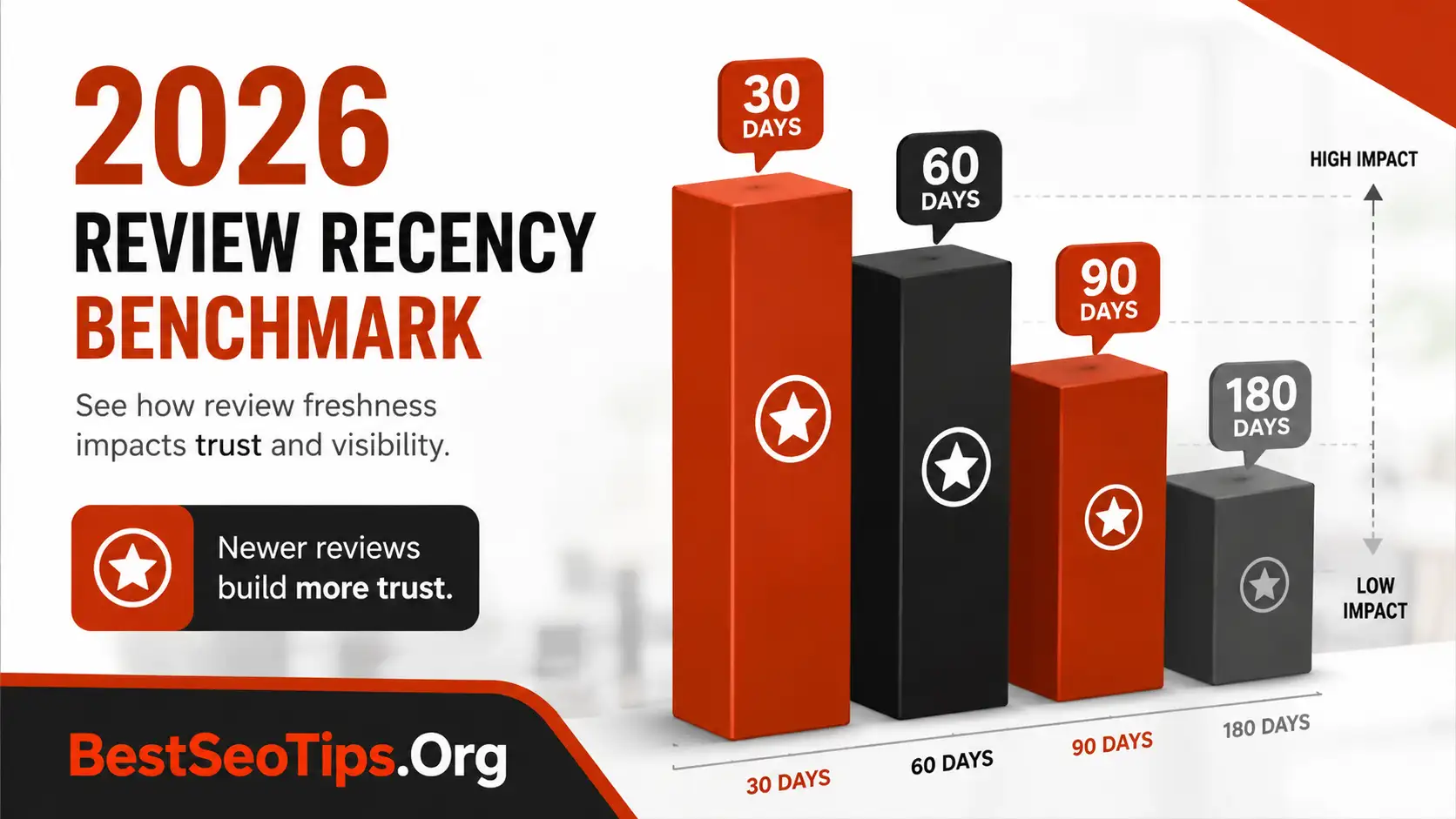
A recent review in 2026 usually means feedback posted within the last 90 days. That is the practical trust window many consumers now use when comparing local options. For some buyers, even that is not enough. A meaningful group looks for reviews posted in the last 2 weeks.
For local seo, the closer the review is to today, the better it supports freshness. If your last review was months ago, potential customers may question whether your current service still matches your older star rating. That can weaken confidence before they ever click.
The fix is simple. Make each review request part of your normal workflow after service completion or a positive customer interaction. Use a direct review link, SMS, or QR codes to reduce friction and bring in fresh responses consistently.
Why Review Recency Has Surpassed Volume This Year
The biggest change this year is how people evaluate trust. A large review volume still helps, but old feedback no longer creates the same confidence on its own. Buyers want proof that your business is performing well right now, not just that it did well in the past.
That matters even more because discovery is wider now. Consumers use local search, AI tools, video platforms, and traditional review sites. Google’s ai and other systems also summarize recurring themes, so current feedback shapes your social proof in a more visible way.
- Fresh reviews suggest operational consistency.
- Ongoing activity looks stronger than short campaign bursts.
- New feedback gives future customers a clearer picture of today’s experience.
In short, recency has passed volume because people and platforms both reward what feels current. If your review profile looks inactive, even a high review count can feel stale.
The 2026 Recency Decay Curve Explained
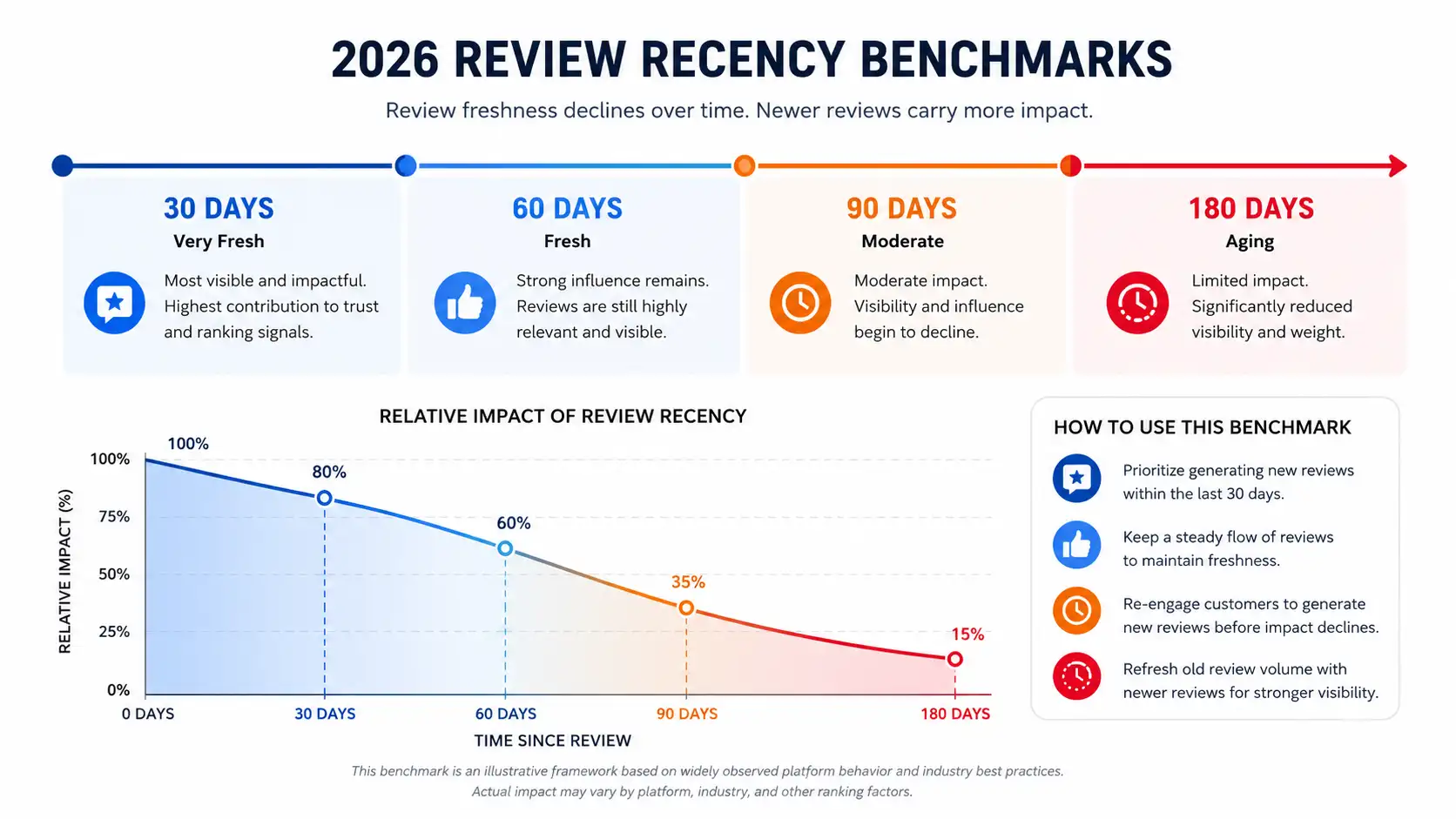
Review recency follows a simple pattern: the older a review gets, the less impact it has on trust. That is the recency bias businesses are dealing with in 2026. A review from last week feels more useful than one from last year, even if both are positive.
For reputation management, this means measuring freshness by age bands, not just totals. Look at how many review signals came in during the last 30, 90, and 180 days. That gives you a practical way to judge whether your profile still feels active enough.
How Review Influence Drops Over 30, 90, and 180 Days
Think of review decay as a sliding scale. The first 30 days are your strongest window because the feedback feels immediate. By 90 days, many consumers still see it as useful. By 180 days, the influence is much weaker, especially if no new google reviews have appeared since then.
You can measure your review profile by checking how many positive reviews sit inside each time range. That will show whether your business looks current or quiet.
| Time since review | Likely influence on trust and visibility |
|---|---|
| 0-30 days | Strongest freshness signal; feels highly current |
| 31-90 days | Still valuable; often within consumer comfort range |
| 91-180 days | Noticeable review decay; trust starts to soften |
| 180+ days | Limited freshness value unless supported by newer activity |
This does not prove a public algorithm rule, but 2026 behavior clearly favors recent feedback. Businesses that keep reviews moving avoid the stale look that hurts conversions.
Measuring Freshness—What Is the New “Critical Window”?
The new critical window is the last 90 days. That is where review freshness has the clearest impact on trust because most consumers want feedback that recent. Inside that range, the last 14 days can be especially powerful for buyers who want very current proof before acting.
So how do you measure it? Start with a simple count of new reviews received in the past 30, 60, and 90 days. Then compare that to your review velocity. If you only get reviews during occasional pushes, your profile may look active for a short time and then go quiet.
A better review strategy is ongoing. Build each review request into your service flow, use direct links or SMS, and track whether you are adding fresh feedback every month instead of waiting for a slow period.
Consumer Expectations Around Review Timing: 2026 Insights
The local consumer review survey shows that timing now shapes trust in a big way. In 2026, 74% of consumers only care about reviews written within the last 3 months. On top of that, 32% specifically look for reviews from the last 2 weeks.
That changes how you should think about local seo and review growth. If your newest feedback is too old, your business may appear less dependable. Industries with frequent customer transactions or urgent buying decisions often feel this pressure most, which makes consistency essential.
What U.S. Consumers Now Consider “Fresh” Feedback
U.S. consumers have set a much tighter standard for fresh feedback. Most now want a recent review from the last 3 months, and a sizable group prefers something much newer. That means review recency is no longer a minor detail inside your review profile. It is a first-check trust signal.
This also supports the need for a working review engine. If reviews only show up after occasional campaigns, your business can look inactive between bursts. Buyers notice that gap even if your average rating stays high.
- Fresh usually means within 90 days.
- Very fresh often means within 14 days.
- Stale begins when no new activity appears for months.
For business owners, the takeaway is simple: keep the profile moving. A live stream of current experiences feels more believable than old praise sitting untouched.
Survey Data: How Recency Impacts Local Purchase Decisions
The survey data shows that customer reviews influence action, not just awareness. Most consumers read reviews for local businesses, and many always read them before choosing where to spend money. Positive reviews raise confidence, but timing changes how persuasive that confidence feels.
Here is the bigger point: people do not stop at the first glance. After reading reviews, many continue their local search by visiting the website, reading more feedback, or checking social profiles. That means your local pack visibility can open the door, but fresh proof helps move the buyer forward.
When the newest review is current, buyers are more likely to believe your service claims still hold up. When reviews are old, even strong sentiment can feel less reliable. In 2026, recency supports the purchase path from discovery to decision.
Setting Monthly Review Targets by Business Type
One major trend in 2026 is the move from random review collection to clear monthly review targets. Business owners need a review frequency that matches customer volume, not a one-size-fits-all number. The goal is steady review velocity, not occasional spikes.
The survey-backed cadence is practical. High-volume businesses should aim for 3 to 10 new reviews per week, mid-volume businesses for 1 to 3 per week, and low-volume businesses for 2 to 4 per month. Next, it helps to break that down by business type.
Ideal Review Frequency for Restaurants, Services, and Retail
The ideal review frequency depends on how often customers interact with you. Restaurants usually have high transaction volume, so they need a faster pace. Service businesses may have fewer jobs but still need steady follow-up. Retail often sits somewhere in the middle depending on foot traffic and order volume.
A practical way to set monthly targets is to match your category to the recommended cadence from the survey and keep it consistent. What matters most is rhythm, not chasing a giant burst.
- Restaurants: often fit the high-volume range of 3 to 10 reviews per week.
- Services: often fit the mid-volume range of 1 to 3 reviews per week.
- Retail: may range from mid-volume to low-volume, depending on customer flow.
If you run an HVAC company or another local service, asking after completed work can create a predictable stream without overwhelming your team.
Adjusting Recency Strategies for National vs. Local Brands
A local business and a national brand should not use the same recency strategy. Local operators need review generation tied closely to each location because customers judge the nearest branch, not the brand in general. That makes local freshness a day-to-day priority.
National brands still need current feedback, but their review process may be broader across many platforms and markets. The challenge is making sure each location, not just the parent brand, shows recent activity and relevant service quality.
Older reviews still have value because they support history, trust, and volume. But in 2026, recency usually leads when a buyer is deciding now. The best approach is balance: keep the long-term record, then layer in a steady flow of new proof at the location level.
Recency vs. Velocity vs. Volume: Key Differences for 2026
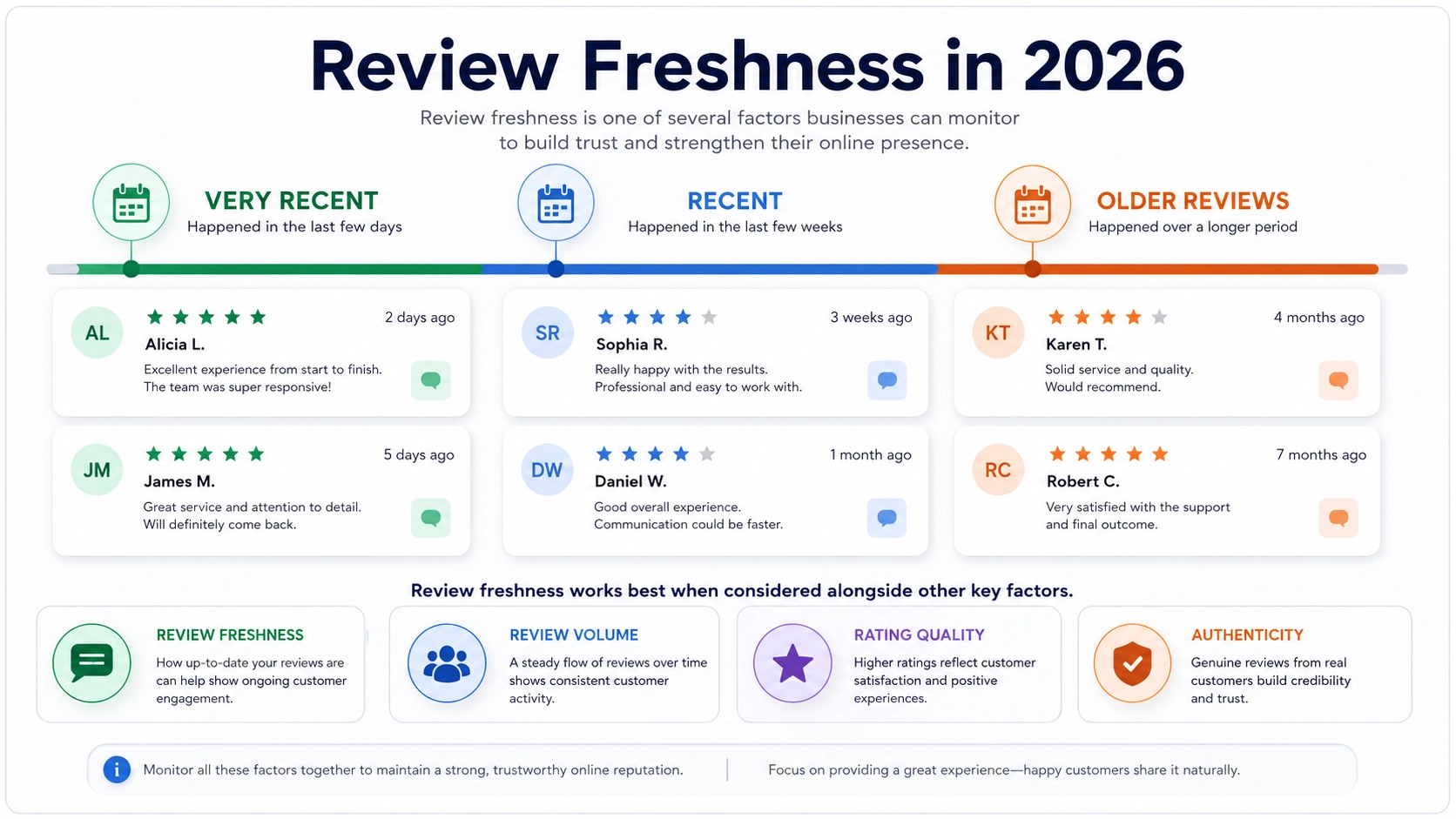
These three terms sound similar, but they do different jobs. Review recency is about how new your latest feedback is. Review velocity is the pace at which reviews arrive. Review volume is your total number of reviews. In 2026, each one matters, but they are not interchangeable.
A healthy review engine combines all three with review quality. You want recent comments, a steady flow, and enough total proof to look established. If one part is missing, your profile can feel either weak, stale, or inconsistent.
Defining Velocity and Volume vs. Recency
Start with the basics. Review recency asks, “How old is my newest feedback?” Review velocity asks, “How often do reviews come in?” Review volume asks, “How many reviews do I have overall?” Together, they shape your local seo strength and review growth pattern.
You can measure them without complex tools. Check the date of your last review, count how many came in during the last 30 and 90 days, and compare that with your total lifetime reviews. That gives you a clear snapshot of freshness versus scale.
- Recency shows whether your profile feels current.
- Velocity shows whether feedback arrives consistently.
- Volume shows whether your business looks established.
In 2026, recency and velocity often drive perception faster than volume alone. A large total helps, but a quiet profile can still underperform.
Can Old Reviews Still Matter or Does Recency Outweigh All?
Old reviews still matter because they prove your business has a track record. They support star rating stability, show long-term review quality, and help buyers see that good experiences were not isolated. That historical base still has real value.
Even so, review recency has become the stronger short-term trust signal. If all your positive reviews are old, customers may wonder whether your service has changed, your staff has turned over, or your standards have slipped. That doubt can hurt before they contact you.
So recency does not erase old reviews. It reframes them. Think of older feedback as your foundation and newer feedback as your proof of present performance. In 2026, you need both, but fresh reviews usually carry the deciding weight.
Frequently Asked Questions
What Is the Ideal Review Frequency for Google Ranking in 2026?
There is no single number for google ranking, but steady review frequency matters. High-volume businesses should aim for 3 to 10 google reviews per week, mid-volume for 1 to 3 per week, and low-volume for 2 to 4 per month. Strong review velocity supports review recency.
Have Google’s Review Algorithms Changed Their Priorities in 2026?
The compiled data does not confirm a public rule change in review algorithms, but 2026 behavior clearly favors review recency. Google’s ai and other discovery tools surface current themes, while consumers also expect fresh feedback. That makes recent activity, star rating, and local seo performance work more closely together.
How Do Businesses Track Their Review Recency Effectively?
Use simple review monitoring inside your google business profile and other platforms. Track the date of your latest review, count review signals from the last 30, 60, and 90 days, and watch gaps in activity. That gives you a clear view of review recency across your full review profile.
Conclusion
In summary, understanding review recency is essential for businesses aiming to enhance their online reputation in 2026. The shift towards valuing recent reviews over volume emphasizes the importance of freshness in consumer feedback. By staying aware of consumer expectations and setting appropriate review targets, businesses can adapt their strategies effectively. Remember, maintaining a balance between recency and overall feedback is crucial for sustained growth. If you want to optimize your review strategy further, don’t hesitate to reach out for a free consultation. Let’s get started on enhancing your online presence!

Harper Wilson
Harper Wilson writes about software review platforms and the importance of customer feedback in today's business decisions. She covers G2, Capterra, Reviews.io, and other top review sites. Her articles look at profiles, ratings, getting reviews, customer feedback, and reputation. Harper also shares how businesses can use reviews to appear more trustworthy, understand what people feel, and boost their online presence. She works to provide clear ideas and useful tips that help businesses keep up with online reviews and use customer feedback more effectively.