
Cost to Build a Review Platform Like Trustpilot in 2026
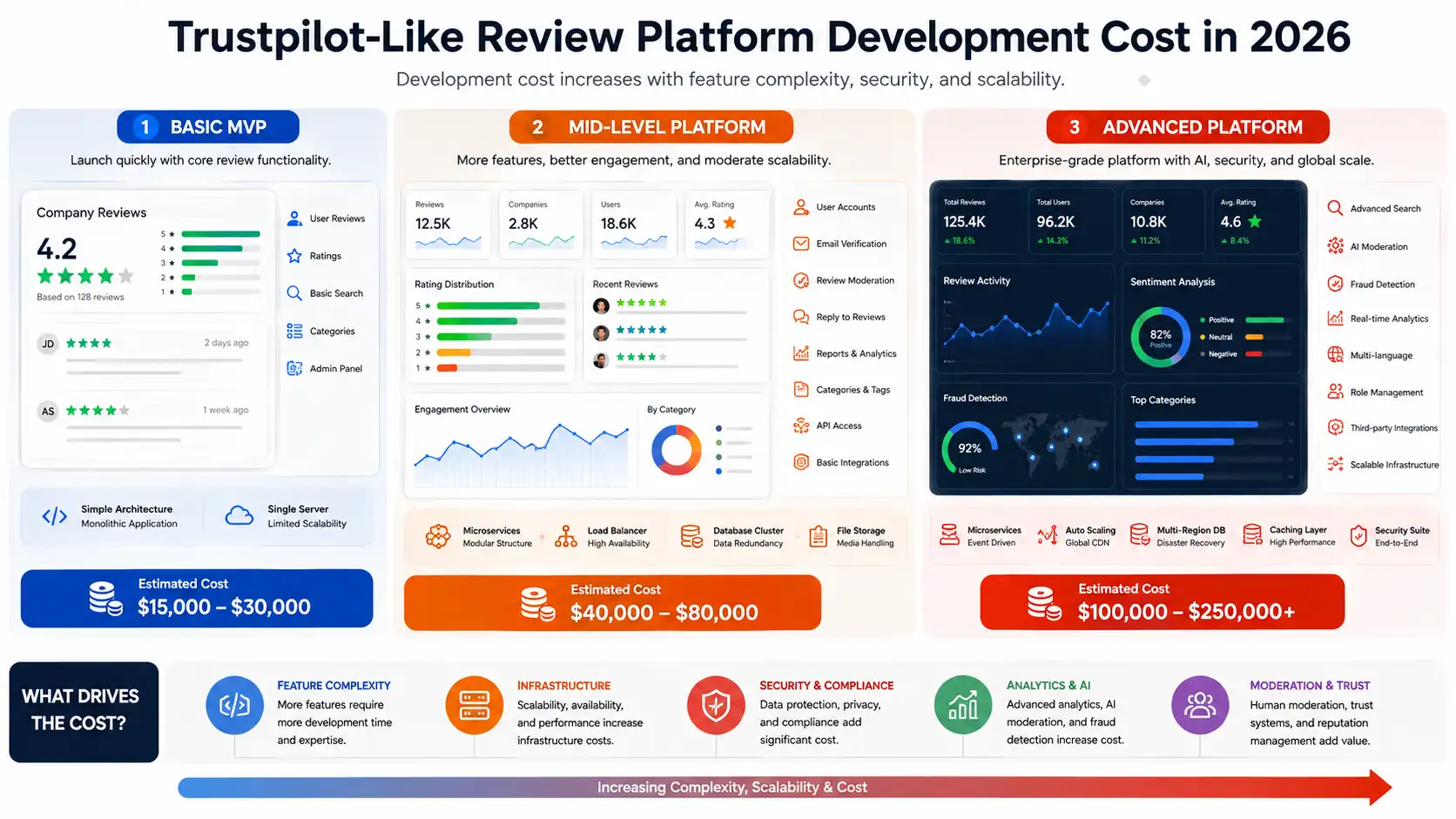
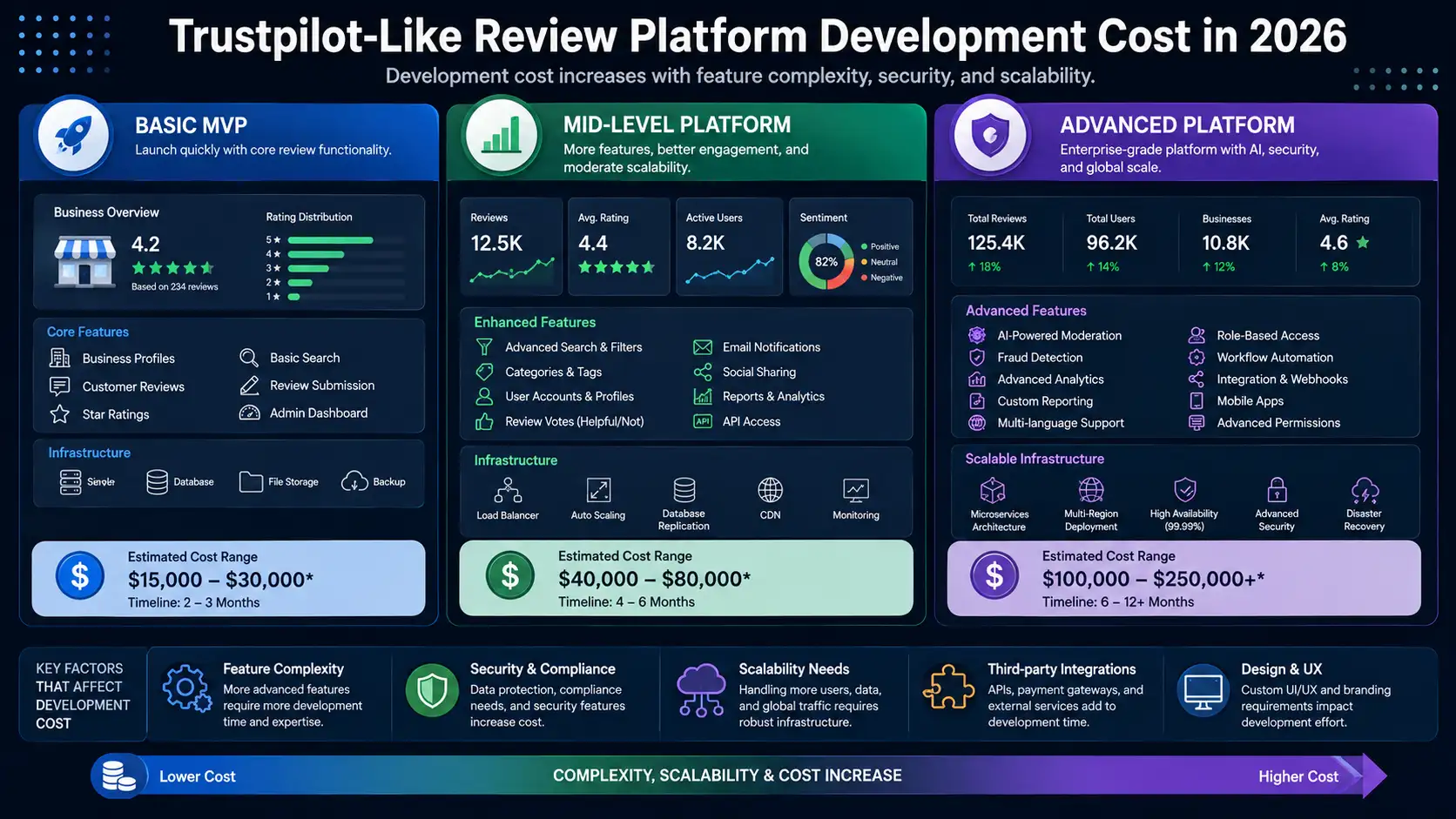
In 2026, the cost to build a review platform like Trustpilot can range from around $15,000 for a focused MVP to $100,000+ for a fully featured, scalable platform. The final development cost depends on the platform’s features, technology stack, review moderation system, user and business dashboards, security requirements, integrations, and scalability.
Review Platform Development Cost Benchmarks
- Basic MVP: $15,000–$50,000 — Core business listings, user accounts, ratings, reviews, search, and basic administration.
- Mid-Level Platform: $50,000–$100,000 — Advanced search, business dashboards, review management, analytics, notifications, moderation, and monetization features.
- Advanced Platform: $100,000+ — Scalable architecture, sophisticated moderation and fraud detection, AI-assisted features, advanced analytics, APIs, enterprise security, and high-volume infrastructure.
What Determines the Cost?
The biggest cost factors are feature complexity, UX/UI design, backend architecture, review verification and moderation, search functionality, payment integration, business dashboards, AI or fraud-detection capabilities, security, and expected traffic. A simple niche review website can therefore cost considerably less than a global platform designed to handle millions of users and reviews.
Key Features of a Trustpilot-Like Platform
A competitive review platform typically needs:
- User registration and authentication
- Business profiles and listings
- Star ratings and written reviews
- Review verification and moderation
- Business responses to reviews
- Search and category filters
- User and business dashboards
- Review notifications
- Analytics and reporting
- Subscription or premium business plans
- SEO-friendly review pages
- Fraud and spam detection

Overview of Building a Review Platform Like Trustpilot
Building a review platform like Trustpilot means creating a place where real users can share customer reviews and buyers can use that information to make decisions. That sounds simple, but the real work sits underneath. Your review website needs a reliable review engine, strong moderation, secure accounts, and systems that protect trust from day one. If users doubt the content, the platform loses its purpose.
The main factors that affect cost are scope, niche, review volume, and advanced features such as AI moderation, fraud detection, review widgets, and better search. Your tech stack also matters because speed, scalability, and data security shape long-term performance. If you want a trustpilot alternative that stands out, you need more than a clean design. You need systems that protect authenticity and support growth. That leads directly to why these platforms matter so much now.
What Makes Review Platforms Essential for Businesses in 2026
Buyers now rely on social proof before they commit. For small businesses and larger brands alike, a single review platform can influence leads, conversions, and reputation management. Reviews are no longer a side feature. They shape how businesses today earn credibility.
What should you include? Start with review collection, business listing pages, clear profile management, review submission, moderation tools, and a dependable star rating system. These are the basics that support building trust. Without them, user feedback feels scattered and less useful to potential customers.
There is also a clear market gap. Niche platforms keep winning because many industries still lack one trusted place for honest opinions. If buyers are making high-stakes decisions and businesses care about reputation, the opportunity is real. That is why understanding how Trustpilot works is useful before you build your own version.
How Does Trustpilot Work?
At its core, Trustpilot collects trustpilot reviews from real users and shows them in a structured way that buyers can scan quickly. Businesses can invite customers to leave feedback, and those review invites help grow review volume over time. The platform turns opinions into visible social proof.
It also organizes review data so people can compare businesses without digging through marketing claims. That is a big reason review websites work so well. They simplify trust. Buyers get a faster path to judgment, while companies get a public record of customer feedback.
Another strength is distribution. Review widgets let businesses display ratings on their own sites, which extends visibility beyond the platform itself. Combined with moderation and account systems, this creates a repeatable loop: collect reviews, display them clearly, and keep trust intact. To do that yourself, you need the right feature set.
Core Features Every Trustpilot-Style Review Platform Needs
Every review platform needs a few non-negotiable features to stay useful and credible. You need business listing pages, secure user accounts, a simple review submission flow, and review invitations that help businesses gather steady feedback. Without these basics, growth becomes hard and user experience suffers.
Just as important, your rating engine and review moderation must work together. One calculates and displays trust signals. The other protects them. In 2026, that balance is what separates a basic directory from a serious review website. Let’s look at each core feature in more detail.
User Registration and Profile Management
User registration is one of the first trust filters on your platform. If anyone can post without checks, fake reviews become easier to spread. A better system uses email verification and options like Google or LinkedIn OAuth to confirm identity and improve user experience.
For reviewers, profile management should feel simple. People need to create accounts, track their activity, and submit feedback without friction. That helps review collection because real customers are more likely to participate when the flow is fast and familiar.
Business profiles matter just as much. Companies need listing pages they can claim, update, and monitor. Those profiles become the home for ratings, reviews, and public responses. When profile management is clean and structured, your review platform feels more reliable to buyers and easier to manage for business owners. After accounts come the tools that handle the reviews themselves.
Review Submission and Moderation Tools
A good review submission flow should be easy for users and strict enough to reduce abuse. If posting takes too long, review volume drops. If it is too loose, fake reviews grow. The right moderation tools create balance by keeping the platform open but controlled.
You should build around a few essentials:
- Review requests and review invites to bring in steady user feedback
- Flagging tools so users can report suspicious posts
- Automated checks for repeated IP activity or unusual patterns
- Human review moderation for edge cases and disputes
These tools matter because trust is your product. A review platform with weak controls may grow fast at first, but it will struggle once authenticity is questioned. Strong moderation also helps businesses feel safer investing time and money into your review site. The next feature group pushes costs even higher, but it often makes the biggest difference.
Fraud Detection, Rating Engine, and AI Moderation
Fraud detection is one of the biggest cost drivers because it protects the authenticity of your reviews. Early-stage founders often cut corners here, then pay for it later. Email verification, IP tracking, and device fingerprinting help catch suspicious patterns before they damage trust.
Your rating engine also needs more depth than a simple average. Strong platforms capture structured review data, overall scores, category-specific ratings, and verified purchase tags where relevant. That added structure helps buyers trust what they see and gives businesses clearer signals.
AI moderation adds another layer. It can speed up review checks, support scale, and reduce manual effort, especially as review volume grows. Still, automation works best alongside human oversight. A trustworthy system usually blends AI moderation, fraud checks, and community reporting. That mix shapes not only quality, but also your final budget. So what should you expect to pay?
Cost Tiers Explained: Building a Review Platform
The cost of a review platform depends on how much you want to build from day one. A simple MVP with a free plan, basic listings, and light moderation costs far less than a platform with custom pricing, AI systems, and premium features for businesses and buyers.
Most projects fall into three tiers: template-based MVPs, custom-built MVPs, and full-featured platforms. Each tier changes what you can launch, how fast you can scale, and how well you can compete. Here is a closer look at what each budget range usually includes.
Basic/Template MVP ($2,000–$15,000)
A basic or template MVP is the fastest way to test demand. In this range, your review platform usually looks more like a basic directory with user accounts, listing pages, a simple rating display, and review forms. It is useful if you want to validate a clear niche before investing more.
This path is often the most cost-effective alternative to a fully custom build. It works well for startups, local businesses, or founders who want to launch quickly and learn from early users. A free plan for listed businesses can help bring in inventory without adding too much friction.
Still, there are trade-offs. You will likely have fewer moderation tools, limited automation, and less flexibility as review volume grows. If trust and scale become priorities, you may outgrow this setup fast. That is where a custom-built MVP starts to make more sense.
Custom-Built MVP ($15,000–$50,000)
A custom-built MVP gives you more control over branding, workflow, and user experience. This is the range many serious founders choose when they want a better product without going fully enterprise. It can include stronger review collection flows, cleaner business profiles, and a more polished star rating system.
You also get room for custom pricing models. That matters if you plan to offer premium features later, such as profile upgrades, analytics, or better visibility for businesses. A custom build gives you more freedom to align the platform with your business goals from the start.
For many niches, this is the practical middle ground. You are not overspending early, but you are investing enough to build trust properly. If you want stronger moderation, better search, and a platform that can evolve, this tier often delivers the best balance. Enterprise platforms sit in a very different category.
Full-Featured Platform ($100,000+)
A full-featured platform is built for scale, monetization, and long-term market leadership. At this level, you are paying for advanced features, stronger infrastructure, better fraud prevention, and tools that support both businesses and power users. This usually fits founders targeting a large niche or building for enterprise buyers.
Here is a simple comparison:
| Tier | Typical Scope | Key Features | Best Fit |
|---|---|---|---|
| Basic/Template MVP | Fast launch, limited flexibility | Basic listings, simple reviews, free plan | Local or early-stage ideas |
| Custom-Built MVP | Branded product with stronger UX | Custom flows, better moderation, improved search | Startups testing real demand |
| Full-Featured Platform | Enterprise-grade review site | AI moderation, api access, detailed comparison exports, scalability | Large niches and enterprise sales teams |
This level also requires a deep understanding of your target audience. Features like api access and detailed comparison exports only matter if users truly need them. High spend makes sense when the market gap is clear and the monetization path is strong.
Beginner’s Guide: How to Build a Review Platform Like Trustpilot
If you want to build a review platform from scratch, start with the basics before you chase scale. The right path begins with business goals, a clear niche, and a review website structure that makes trust easy to understand for both reviewers and buyers.
Your tech stack matters because it affects speed, cost, and how well the product handles growth. But technology alone will not save a weak idea. First define the market gap. Then choose tools and people that fit your stage. These next steps will help you map that out.
What You Need to Get Started (Tech Stack, Team, Budget)
Before building your review site, get clear on three things: the product, the people, and the spend. Many business owners rush into development before setting those basics. That usually leads to wasted budget and a weaker launch.
Your starting checklist should include:
- A tech stack that supports speed, trust, and future review volume
- A development team that understands moderation, data structure, and user flows
- A realistic budget range tied to your launch stage
- A monetization plan, whether free listings, custom pricing, or premium upgrades
On the technical side, React or Next.js can support the frontend, while PostgreSQL handles structured review data. Elasticsearch becomes useful when search and filtering grow more complex. Strong hosting, HTTPS, and secure storage are also part of the foundation. Once those are in place, your next move is choosing the right market.
Step 1: Define Your Niche and Target Audience
Choosing a clear niche is the most important early decision. Trying to beat Trustpilot across every category is not a practical plan. A focused market gives you a better chance to build trust, attract useful review data, and create a platform people actually return to.
Ask simple questions. Are buyers making high-stakes decisions here? Is there no trusted voice yet? Do businesses care enough about their reputation to pay later? If the answer is yes, you may have a real opening.
You also need a deep understanding of your target audience. Your review platform serves two groups at once: the person leaving feedback and the person using it to decide. Miss either side and the product weakens fast. Validate early through real conversations and existing communities before you move into the build phase.
Step 2: Choose the Right Tech Stack and Hosting
Your tech stack shapes both cost and future flexibility. For the frontend, React or Next.js are strong options because they support a fast, responsive review website. That matters when users need quick search, clear review cards, and easy filtering.
On the data side, PostgreSQL works well for structured reviews, ratings, and business profiles. If you expect larger review volume, Elasticsearch can improve search quality and category filtering. These choices affect development effort, but they also affect how usable the product feels later.
Hosting and security matter just as much. Use HTTPS, protect user data responsibly, and plan for scalability early. If you expect premium buyer tools such as api access or business-facing review widgets, your architecture should support them from the start. Once the foundation is ready, you can move into delivery.
Step 3: Develop, Test, and Launch Your Review Platform
A focused MVP review platform can often launch in three to four months. A larger review site with advanced features may take eight to twelve months. The smartest approach is usually to launch lean, learn from user behavior, and improve the product in stages.
Your development team should test trust-critical functions before launch:
- User registration and authentication
- Review moderation and reporting flows
- Review invites and collection journeys
- Search, filters, and business profile accuracy
Do not wait for perfection. A smaller launch with strong trust systems is better than a polished site with weak controls. Test the buyer journey, the reviewer journey, and the business listing experience. If all three feel clear and reliable, you are in a better position to grow. From there, your cost picture becomes easier to judge in context.
Frequently Asked Questions
What are the main factors that influence the cost of building a review platform?
The cost of a review platform depends on your tech stack, the size of your development team, and how many advanced features you need. Custom pricing models, fraud controls, moderation systems, and search functionality all increase complexity. The more trust-focused systems you build, the higher the investment.
How do ongoing maintenance costs compare to using Trustpilot?
A custom review platform gives you more control, but ongoing maintenance becomes your responsibility. That includes hosting, moderation, updates, compliance needs, and customer support. A trustpilot alternative can be more flexible long term, while using Trustpilot means paying for access instead of managing the system yourself.
Is it better to build or buy a white-label review solution?
It depends on your business goals. A white-label review platform or template setup can help you launch faster and spend less early on. If your review site needs custom workflows, deeper trust controls, or a specialized tech stack, building your own platform usually makes more sense.
How long does it take to build a review site like Trustpilot?
A lean review platform MVP can often be ready in three to four months. A larger review site with stronger moderation, custom workflows, and advanced product reviews features may take eight to twelve months. Your development team, scope, and launch standards will shape the final timeline.
Conclusion
A realistic 2026 budget for a Trustpilot-like review platform is approximately $15,000–$50,000 for an MVP, while a more advanced and scalable platform can exceed $100,000. Startups can reduce initial costs by launching with essential review and business-listing features first, then adding advanced moderation, analytics, monetization, and AI capabilities as the platform gains users.
These are development-cost benchmarks, not fixed market prices. Actual costs vary significantly depending on the development team, location, technology, number of features, integrations, security requirements, and expected scale. Current published estimates also vary—for example, some providers advertise much lower template/clone-style solutions—so the scope behind each quote should always be compared before choosing a development approach.

Amy Evans
Amy Evans is a digital content writer. She focuses on Trustpilot and how companies can manage what people say about them online. She writes helpful guides on Trustpilot reviews, TrustScore, business profiles, inviting people to write reviews, replying to customer feedback, negative reviews, and Trustpilot's rules. Amy wants to make Trustpilot easy to understand. She helps businesses use what customers say to build trust, improve their online reputation, and grow steadily.